HomeCoursesEmployment Law and Human Resources Management

The ILO Conventions

Chapter 3 · International sources · lesson 3 of 132
Sample exercise available for free
State and professional regulations
The principles governing employment relationships within a company and social protection come from various sources. A distinction should be made between international sources, European and national sources.

International sources

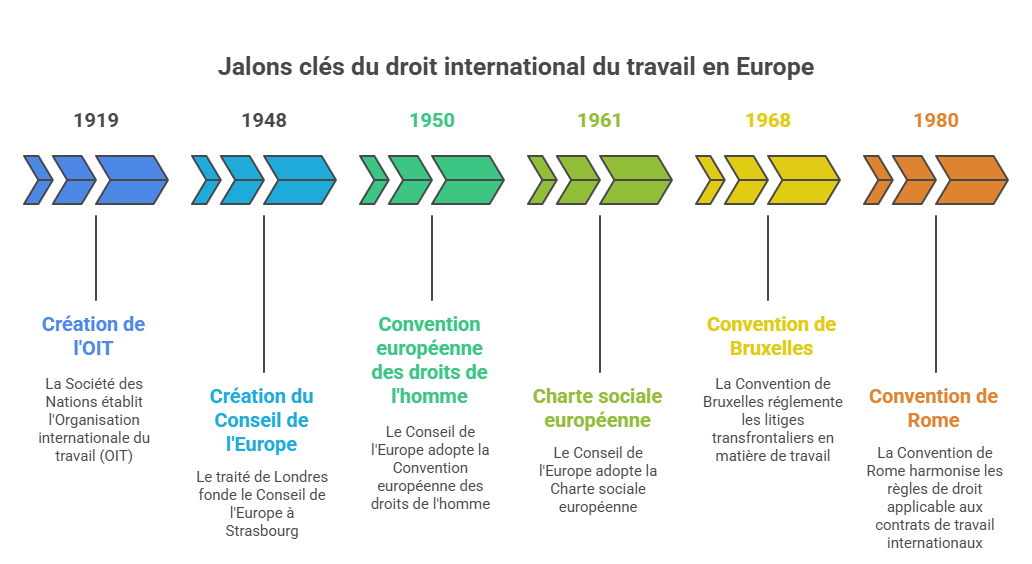
In 1919, after the First World War, the League of Nations created, by the Treaty of Versailles, l'International Labour Organization (ILO), responsible for issues related to labour.


In 1948, after the Second World War, the Treaty of London established the Council of Europe, based in Strasbourg. This council drew up the European Convention for the Protection of Human Rights and Fundamental Freedoms in 1950 and the European Social Charter in 1961.
This first text may be invoked in disputes relating to employment relationships before national courts, and the European Court of Human Rights ensures its application by Member States, including France.

Since then, the Brussels Convention and 1968 and the Rome Convention and 1980 have governed the international employment relations, in particular with regard to the applicable law and the competent court for international employment contracts.
This international law indeed fulfills two very distinct functions.

It thus seeks to develop substantive law at the international level, aiming to apply uniform rules to as many national territories as possible, in order to settle issues relating to labor law by harmonizing the various national laws. For example, the prohibition of child labor.

Either way, due to the weakness of substantive law, it does not seek to develop international standards applicable in national territories, but rather to designate, through conflict of laws rules, the applicable domestic national law for an international situation.

Example

The Rome Convention determines which law must apply in the event of the dismissal in Great Britain of a French employee by a Belgian employer, whether it be French law, British law, Belgian law, or another law.

The ILO Conventions


The International Labour Organization develops international conventions that are adopted by the International Labour Conference. This conference, composed of tripartite delegations, includes for each State representatives of the government, the most representative trade unions, as well as employers and employees.

Once adopted, conventions are subject to possible ratification by Member States.

Once ratified, conventions become binding and incorporate into domestic law. If earlier legislation conflicts with a ratified convention, the provisions of the latter take precedence over the law. These conventions address general issues, such as collective bargaining or freedom of association, or concern specific categories, such as women, young people or seafarers.

Recommended books
  • International Labour Law by David M. Trubek
    This book provides an in-depth analysis of international labour law, with a particular focus on ILO conventions and their impact on national systems.
  • The International Labour Organization and the International System by David A. R. Williams
    A work detailing the history and evolution of the ILO and the conventions it has created, with a perspective on the contemporary challenges of labour law on a global scale.
  • Labor Law in the Global Economy by Paul Davies and Richard Freedman
    A book that addresses the challenges of international labour law, with an emphasis on ILO principles and conventions in the context of globalisation.
TED Talks

Create your free account

No credit card required, in thirty seconds.
Continue with Google
or
Sign up with an e-mail
Already registered? Log in
By continuing, you agree to the terms of use and the privacy policy. Your data is hosted in the European Union.

Full access DATAGOZ

19 €/ month — or 190 € / year
  • All published courses and career paths
  • Exercises and quizzes with automatic grading
  • Practice, exam and certificate of completion
  • No commitment, cancel online
See the plans
This lesson is part of the course

Employment Law and Human Resources Management

short_training41 chapters · 132 lessons

Grasp the essentials of Social Law and Human Resources Management!

  • Welcome Messagesubscribers
  • Introductionsubscribers
  • ILO Conventionsyou are here
  • Bilateral treatiessubscribers
  • Conventions on conflict of laws and jurisdictionsubscribers
  • Treatiessubscribers
  • Secondary European Union lawsubscribers
  • The case law of the Court of Justice of the European Unionsubscribers
  • State sourcessubscribers
  • Non-state or professional sourcessubscribers
  • The principle of the most favourable rule for the employeesubscribers
  • Exceptions to the principle of favoursubscribers
  • Formalities prior to hiringsubscribers
  • Restrictions on freedom of hiringabonnés
  • Hiringabonnés
  • Formalities related to hiringabonnés
  • Definition of the employment contractabonnés
  • Conditions for forming the contractabonnés
  • The permanent employment contract (CDI)abonnés
  • Exceptional contractsabonnés
  • The labour inspectorateabonnés
  • The occupational health serviceabonnés
  • URSSAFabonnés
  • Undeclared worksubscribers
  • Civil, criminal and administrative courtssubscribers
  • Employment tribunalssubscribers
  • The special jurisdiction of the industrial tribunal (conseil de prud’hommes)subscribers
  • The industrial tribunal proceduresubscribers
  • The right to strikesubscribers
  • Running the company during a strikesubscribers
  • Legal remediessubscribers
  • Settling collective disputessubscribers
  • The legal working timesubscribers
  • Effective working timesubscribers
  • Overtimesubscribers
  • Compensatory restsubscribers
  • On-call dutysubscribers
  • Equivalence hourssubscribers
  • Fixed-price (flat-rate) agreementssubscribers
  • Derogations from exceeding working hourssubscribers
  • Part-time worksubscribers
  • Weekly restsubscribers
  • Public holidayssubscribers
  • Paid leavesubscribers
  • Other specific paid leavesubscribers
  • Other unpaid leavesubscribers
  • Secure external mobilitysubscribers
  • Changes to working conditionssubscribers
  • Modification of the employment contractsubscribers
  • Change in the employer's legal situationsubscribers
  • Conditions for applying Article L. 1224-1subscribers
  • Application of L. 1224-1 in case of loss of contractsubscribers
  • Effects of Article L. 1224-1subscribers
  • Salarysubscribers
  • Salary supplementssubscribers
  • Setting the salarysubscribers
  • Payment of salarysubscribers
  • The internal regulationssubscribers
  • Texts equivalent to internal regulationssubscribers
  • The employer's power to impose sanctionssubscribers
  • The employee's misconductsubscribers
  • The disciplinary sanctionsubscribers
  • The disciplinary proceduresubscribers
  • Time limits for misconduct and sanctionssubscribers
  • Review of the sanction imposedsubscribers
  • Employer's managerial authority and fundamental freedomssubscribers
  • Employer's managerial authority and physical protectionsubscribers
  • Bodies responsible for enforcing health and safety rulessubscribers
  • Employer sanctionssubscribers
  • Employer sanctionssubscribers
  • The existence of a real and serious causesubscribers
  • The dismissal proceduresubscribers
  • Definition of economic dismissalsubscribers
  • Grounds for dismissalsubscribers
  • Preliminary steps before dismissalsubscribers
  • Economic dismissal proceduressubscribers
  • Penalties for unlawful dismissalssubscribers
  • Notice periodsubscribers
  • Redundancy paysubscribers
  • Certificate of employmentsubscribers
  • Receipt for full and final settlementsubscribers
  • Pôle emploi certificatesubscribers
  • Settlement agreementsubscribers
  • The characteristics of resignationsubscribers
  • The consequences of resignationsubscribers
  • Termination of the employment contract by the employee's 'prise d'acte'subscribers
  • Termination of the employment contract by judicial order (résiliation judiciaire)subscribers
  • Compulsory retirementsubscribers
  • Voluntary retirementsubscribers
  • The different cases of negotiated departuresubscribers
  • The conditions of validitysubscribers
  • The mutual agreement terminationsubscribers
  • Force majeuresubscribers
  • Terms of exercisesubscribers
  • Form of the right of expressionsubscribers
  • Protection of the right of expressionsubscribers
  • Trade union representation in the companysubscribers
  • Staff representativessubscribers
  • Works councilssubscribers
  • Designation of employee representativessubscribers
  • Management of union leave hourssubscribers
  • Protection of union representatives and staffsubscribers
  • Protection against discriminationsubscribers
  • The offence of obstructionsubscribers
  • Incentive schemesubscribers
  • Employee profit-sharing in company resultssubscribers
  • Company savings plansubscribers
  • Intercompany savings plansubscribers
  • Collective retirement savings plansubscribers
  • Companies subject to the social reportsubscribers
  • Content of the social reportsubscribers
  • Procedure for drawing up the social reportsubscribers
  • Conceptsubscribers
  • Historysubscribers
  • The general schemesubscribers
  • Special schemessubscribers
  • Litigation in Social Securitysubscribers
  • Supplementary provident coversubscribers
  • Supplementary pension schemessubscribers
  • Maintenance of supplementary benefits and termination of the employment contractsubscribers
  • Conceptsubscribers
  • Procedure for applying for social assistance and eligibility conditionssubscribers
  • Litigation proceduressubscribers
  • Social assistance benefitssubscribers
  • Benefits for total unemploymentsubscribers
  • Short-time workingsubscribers
  • The different stakeholders in vocational trainingsubscribers
  • The different professional training pathwayssubscribers
  • Contribution to the funding of professional trainingsubscribers
  • Expenses chargeable against the contributionsubscribers
  • Monitoring of training expensessubscribers
  • Course conclusionsubscribers
Next lesson

Bilateral treaties

View the programme Create an account to continue