International sources

In 1948, after the Second World War, the Treaty of London established the Council of Europe, based in Strasbourg. This council drew up the European Convention for the Protection of Human Rights and Fundamental Freedoms in 1950 and the European Social Charter in 1961.
Since then, the Brussels Convention and 1968 and the Rome Convention and 1980 have governed the international employment relations, in particular with regard to the applicable law and the competent court for international employment contracts.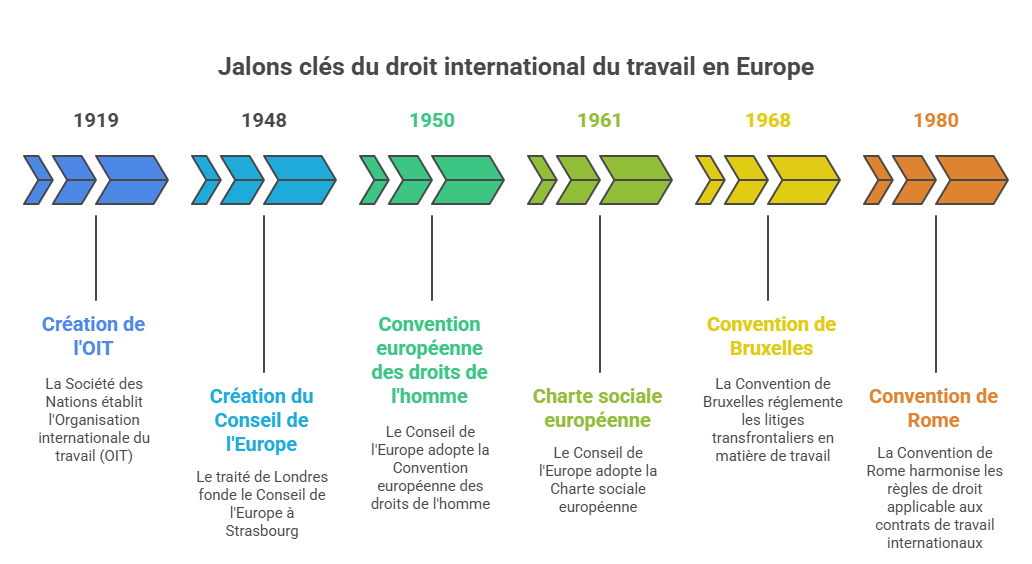
This international law indeed fulfills two very distinct functions.
It thus seeks to develop substantive law at the international level, aiming to apply uniform rules to as many national territories as possible, in order to settle issues relating to labor law by harmonizing the various national laws. For example, the prohibition of child labor.
Either way, due to the weakness of substantive law, it does not seek to develop international standards applicable in national territories, but rather to designate, through conflict of laws rules, the applicable domestic national law for an international situation.
Example
The Rome Convention determines which law must apply in the event of the dismissal in Great Britain of a French employee by a Belgian employer, whether it be French law, British law, Belgian law, or another law.
The ILO Conventions
Once adopted, conventions are subject to possible ratification by Member States.
Once ratified, conventions become binding and incorporate into domestic law. If earlier legislation conflicts with a ratified convention, the provisions of the latter take precedence over the law. These conventions address general issues, such as collective bargaining or freedom of association, or concern specific categories, such as women, young people or seafarers.
Recommended books- International Labour Law by David M. Trubek
This book provides an in-depth analysis of international labour law, with a particular focus on ILO conventions and their impact on national systems. - The International Labour Organization and the International System by David A. R. Williams
A work detailing the history and evolution of the ILO and the conventions it has created, with a perspective on the contemporary challenges of labour law on a global scale. - Labor Law in the Global Economy by Paul Davies and Richard Freedman
A book that addresses the challenges of international labour law, with an emphasis on ILO principles and conventions in the context of globalisation.
- How the ILO fights for workers' rights
A presentation on the role of the ILO in protecting workers' rights at the international level, with an emphasis on its most influential conventions. - A Global Perspective on Labor Rights
This conference explores global efforts to enforce labour standards, highlighting the successes and challenges of ILO conventions.